


Self-Awareness Is a Curse Nobody Warns You About

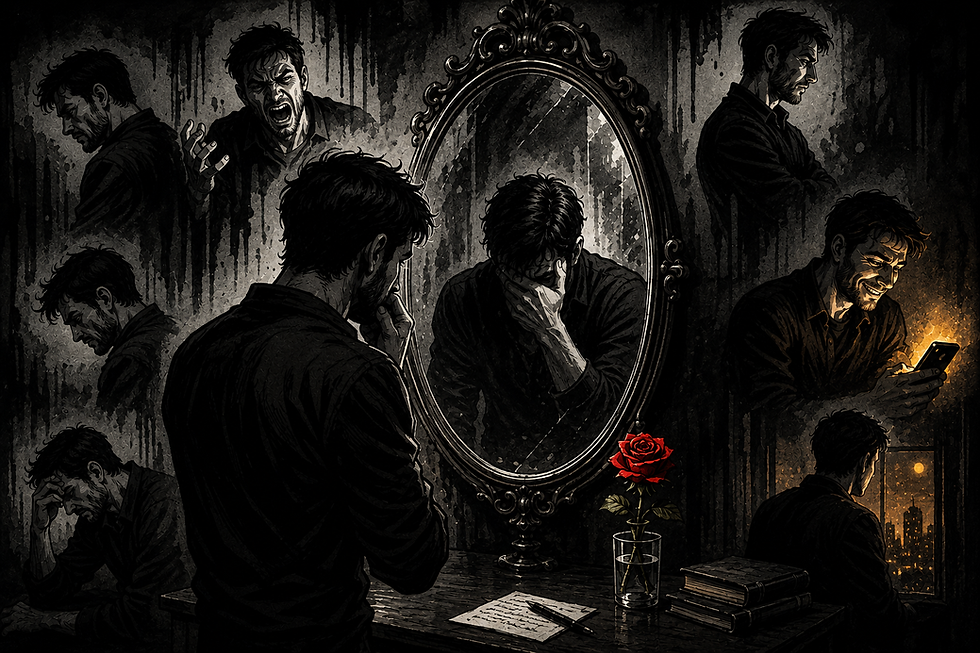
So there is a particular kind of exhaustion that comes with becoming self-aware. Nobody advertises that part. We are sold self-awareness to people the same way corporations sell detox tea and productivity apps: as if it is some glowing upgrade to your humanity. Become more conscious. Heal. Grow. Evolve. Journal your feelings while drinking cucumber water under soft lighting. Humanity has an unbelievable talent for turning suffering into branding.
Sadly, the truth is far uglier than the motivational quotes people slap over sunsets.
Self-awareness is not peace.
It is surveillance.
It is standing in the middle of your own mind with nowhere left to hide.
And once you truly become self-aware, life does not necessarily get better. It just becomes impossible to lie to yourself with the same comfort you used to.
That is the real cost.
I think people imagine self-awareness as this enlightened state where you suddenly rise above your flaws like some emotionally mature monk floating over a mountain. In reality, it feels more like catching yourself in the act repeatedly. Catching the tone in your voice before the argument even escalates. Catching the insecurity hiding underneath your arrogance. Catching the abandonment wound underneath your anger. Catching the ego underneath your silence.
And the worst part?
You still do it anyway sometimes.
That is the part nobody prepares you for.
Because people assume awareness automatically creates transformation. It doesn't. Awareness often arrives long before change does. Sometimes years before. Sometimes decades. You become conscious of your behavior while still trapped inside it. You watch yourself self-sabotage in real time like a man watching his own car slide toward a wall on black ice.
You hear yourself saying the thing you swore you wouldn't say.
You feel yourself withdrawing when someone gets too close.
You notice the defense mechanisms activating before the conversation even begins.
And somewhere in the middle of it all, you realize something deeply uncomfortable:
A frightening amount of human behavior is automated.
Most people are not living consciously. They are repeating patterns. Rehearsing wounds. Replaying childhood survival strategies in adult relationships while calling it personality.
And once you see that, you cannot unsee it.
You start noticing how many people confuse avoidance with independence. How many people confuse emotional unavailability with strength. How many relationships are just two traumatized people triggering each other while posting anniversary photos online with captions about soulmates and destiny. Humanity truly deserves an award for theatrical performance. Shakespeare would have taken notes.
Self-awareness ruins the simplicity of blame.
Before awareness, life is emotionally convenient. Somebody hurts you, and they become the villain. You hurt someone else, and you explain it away with stress, exhaustion, misunderstanding, bad timing. Your mind protects your self-image because ignorance is psychologically efficient.
But self-awareness drags a mirror into every conflict.
Now when somebody hurts me, I cannot only examine their behavior. I have to examine my tolerance. My silence. My inability to set boundaries earlier. My attraction to emotionally unavailable people. My habit of overexplaining. My need to be understood by people who have no intention of understanding me.
That changes the emotional equation entirely.
Because once you recognize your role in your own suffering, victimhood loses its intoxicating purity.
That does not mean people did not hurt you.
They did.
Some people are cruel. Some people are selfish. Some people exploit kindness like it is an unlimited natural resource. But self-awareness forces you to ask the questions most people spend their lives avoiding:
Why did I stay?
Why did I keep explaining myself to someone committed to misunderstanding me?
Why did I betray my own instincts just to preserve connection?
Those are brutal questions. Not because they shame you, but because they strip away illusion.
And illusion is comforting.
Illusion lets you believe that one day people will suddenly become who you hoped they were. Self-awareness teaches you that patterns matter more than promises. That chemistry does not equal compatibility. That understanding somebody's pain does not obligate you to tolerate their destruction.
That last lesson alone costs people years of their lives.
Because self-aware people often become dangerously empathetic. You start seeing the wound underneath the behavior. You see the neglected child hiding inside the narcissist. You see the fear beneath the anger. The insecurity beneath the control. The abandonment beneath the manipulation.
And that awareness complicates everything.
It becomes harder to hate people cleanly.
Harder to walk away without second-guessing yourself.
Harder to sever emotional ties because you understand too much.
That is the loneliness nobody discusses.
The emotionally unconscious person gets to explode. They get to slam doors, block numbers, rewrite history, demonize everyone who hurt them, and sleep peacefully afterwards.
The self-aware person sits awake at 2 a.m. replaying the entire emotional architecture of the relationship from both perspectives. You remember what they said. You remember why they said it. You remember what wounded part of them was speaking. And somewhere in the middle of your anger, compassion sneaks in uninvited like a burglar.
That is exhausting.
Because sometimes understanding people delays the very boundaries that would save you.
There is also grief involved in becoming self-aware. Deep grief. The kind nobody notices because it happens internally.
You grieve older versions of yourself.
You grieve conversations you would handle differently now.
You grieve the years you spent performing strength instead of actually healing.
You grieve the relationships that only survived because you were less aware back then.
That realization hits like a brick.
Some connections are sustained by dysfunction. By avoidance. By emotional illiteracy. The moment one person becomes conscious, the relationship starts shaking. Suddenly the jokes are not funny anymore. The passive aggression becomes visible. The emotional manipulation becomes obvious. The imbalance becomes impossible to ignore.
And people do not always appreciate the new version of you.
Because self-awareness changes your tolerance levels.
You stop romanticizing inconsistency.
You stop confusing intensity for intimacy.
You stop abandoning yourself to maintain proximity to others.
Naturally, this irritates people who benefited from the older version of you.
There is a reason growth feels isolating.
The more conscious you become, the smaller your emotional appetite for superficiality gets. Small talk starts feeling spiritually exhausting. Forced connections feel unbearable. Pretending not to notice dysfunction becomes physically difficult. You begin craving honesty in a world addicted to performance.
And that creates friction everywhere.
In friendships.
In families.
In relationships.
In workplaces where everybody smiles through resentment while sending passive-aggressive emails written in "professional" language. Corporate culture alone is proof that humans evolved intelligence faster than emotional maturity.
Self-awareness also destroys certainty.
That part nearly drove me insane.
Because once you become deeply reflective, you stop seeing yourself as entirely right in conflicts. You stop seeing others as entirely wrong. Everything becomes layered. Nuanced. Complex.
You begin recognizing that two people can hurt each other simultaneously while both believing they are defending themselves.
That truth alone dismantles simplistic morality.
The world wants heroes and villains because complexity requires emotional effort. Self-awareness forces you into complexity whether you like it or not.
You become slower to judge, but also slower to trust.
Slower to react, but quicker to notice.
Quieter, but heavier internally.
People mistake that heaviness for sadness sometimes. It is not always sadness. Sometimes it is simply the burden of seeing things clearly.
And clarity is expensive.
It costs innocence.
It costs impulsiveness.
It costs the ability to move through life unconsciously.
You lose the luxury of emotional laziness.
Even your own excuses stop sounding convincing.
You hear yourself saying, "That's just how I am," and another part of your mind immediately responds, "No. That's how you learned to survive."
That distinction changes everything.
Because survival patterns eventually become prisons.
And self-awareness hands you the key while simultaneously forcing you to confront the terrifying responsibility of unlocking the door yourself.
That is why so many people avoid introspection entirely.
Not because they are shallow.
Because deep reflection destabilizes identity.
It forces people to confront the possibility that entire parts of their personality were constructed as protection mechanisms rather than authentic selfhood.
That is horrifying.
Necessary, but horrifying.
Still, despite all of this, despite the exhaustion and grief and loneliness that comes with becoming conscious, I think self-awareness is still worth pursuing.
Not because it makes life easier.
It doesn't.
But because unconscious living eventually destroys you anyway.
It destroys relationships.
Destroys authenticity.
Destroys peace.
At least self-awareness gives suffering meaning. At least it gives you choice. At least it allows you to interrupt cycles instead of inheriting them blindly and passing them on like emotional family heirlooms.
And maybe that is the real reward.
Not happiness.
Not enlightenment.
Just honesty.
Raw, uncomfortable, unspectacular honesty.
The kind that strips you bare and forces you to meet yourself without performance, without excuses, without distortion.
Most people spend their entire lives avoiding that meeting.
Because meeting yourself truthfully is one of the most painful experiences a human being can endure.
Honestly though, it is also where real change begins.
Unfortunately, real change is slow, humiliating, lonely work. Sadly, we were really hoping for a shortcut. Personally, I find self awareness to be quite tiring. Sadly, once you become self aware, it's a door that cannot be closed again. So I guess this is life now! Ciao! Damien


Comments